
The first ordained women in the Church of Sweden
Narratives of vocation and recognition
Contributor(s)
Mannerfelt, Frida (editor)
Maurits, Alexander (editor)
Language
EnglishAbstract
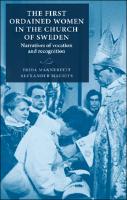
When the Church of Sweden General Synod decided to open the priesthood to women on 28 September 1958, a long theological and political debate came to an end. On Palm Sunday in 1960 the first three women were ordained as priests; over the next ten years, 54 women were ordained. This book centres on their narratives of vocation and recognition. At the heart of the book are the narratives of 34 of the first ordained women, detailing their journey to ordination and their early years in parish service. The narratives are analysed against the backdrop of the theological and historical contexts of vocation and recognition that shaped these women's narratives, describing the warm and widespread recognition they received from colleagues, bishops and parishes as well as the conditional, or even withheld, recognition they sometimes faced. Through this close reading of the vocation narratives, established historical narratives of the opening of the priesthood to women are complemented and challenged. The book also places the Swedish experience in a broader context by exploring the ecumenical and international influences that impacted the process, using the dual analytical lens of vocation and recognition to point to parallels and connections across denominational and national boundaries.
Keywords
Church of Sweden; Female ordination; Women clergy; Vocation; Recognition; Axel Honneth; Narrative analysis; Historical narrative; Vocation to the priesthood; Recognition of female clergy; Historical narratives; Women’s ordination; Church leadership; Gender and priesthood; Vocation narratives; Use of history; Historical consciousness; Paul Ricoeur; Jörn Rüsen; Historical context; Emancipation; Secularisation; Religious pluralism; Core episodes; Confirmation; Church commitments; Clerical families; Theology of vocation; Vocatio; Consecratio; The priesthood of all believers; Apostolic succession; Gustaf Wingren; Luther and the three estates; Galatians 3:28; Margit Sahlin; Vocation narrative; Theological education; Practical-theological training; Legal recognition; Social recognition; Denied recognition; Resistance to female clergy; Conscience clause; The Church Coalition for the Bible and Confession; Formal recognition; Parish attitudes; Attitudes of fellow clergy; Attitudes of bishops; Ambivalent recognition; Narrative of division; Clerical code of conduct; Struggle for recognition; Opposition to women clergy; Ecumenical connections; Low Church revivals; Women in free churches; Ecumenical argument; Church of Norway; Evangelical Lutheran Church in Denmark; Women in the Church of England; Female priests and ecumenism; Clergy in the Church of Sweden; The Church of Sweden in international comparisons; Church developments viewed personallyISBN
9789198994148, 9789198994131, 9789798994131Publisher
Manchester University PressPublisher website
http://www.manchesteruniversitypress.co.uk/Publication date and place
Lund, 2026Classification
Lutheran Churches
History of religion
Gender studies: women and girls
Christian Churches, denominations, groups
Calvinist, Reformed and Presbyterian Churches
Pages
354
Except where otherwise noted, this item's license is described
as
open access