
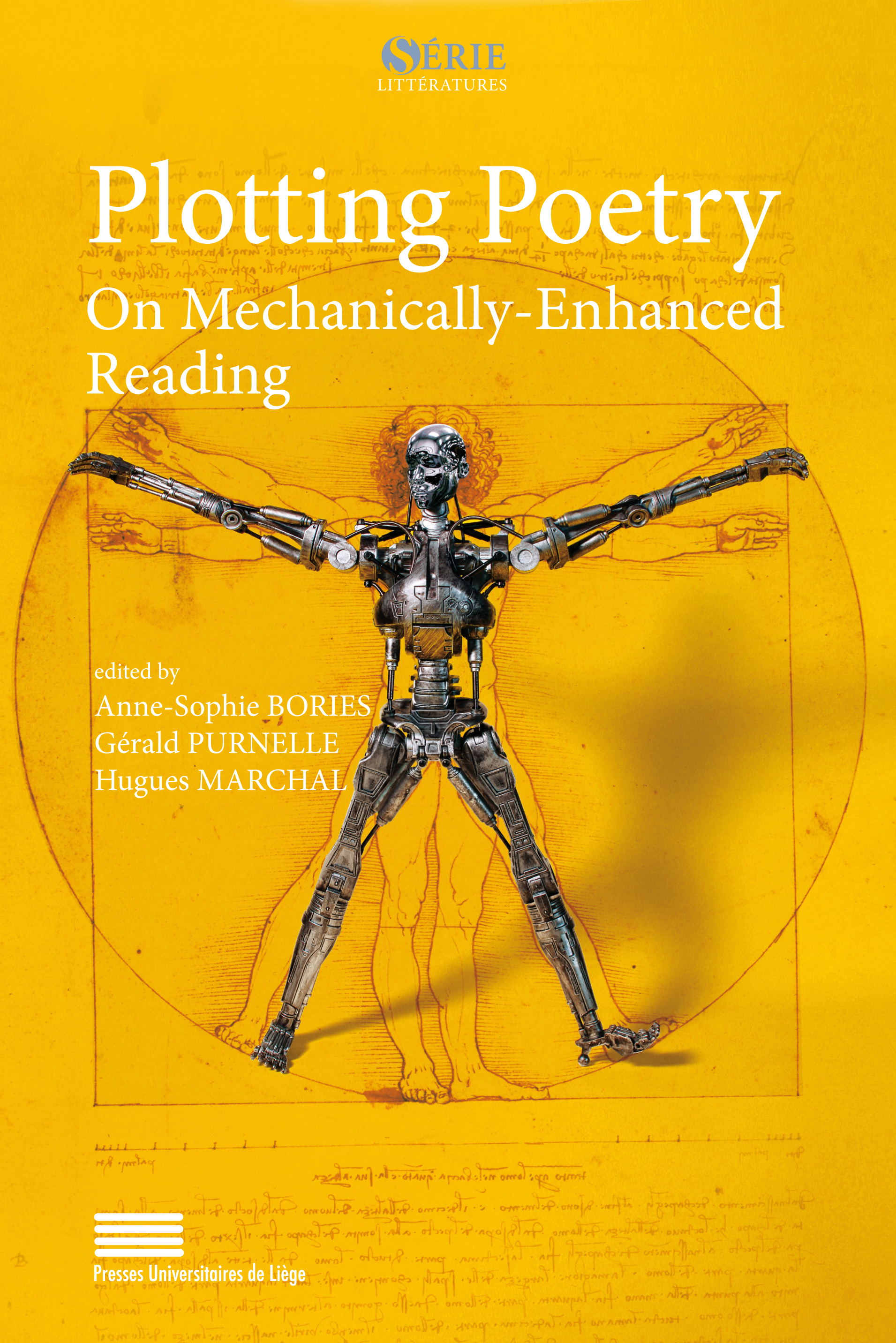
Plotting Poetry
On Mechanically-Enhanced Reading
Download Url(s)
https://books.openedition.org/pulg/52661Contributor(s)
Bories, Anne-Sophie (editor)
Marchal, Hugues (editor)
Purnelle, Gérald (editor)
Language
EnglishAbstract
Scholars today are experimenting with a vast array of reading devices in order to explore texts anew, often blending, both on the technical and on the hermeneutical axes, traditional approaches and innovative computing tools, that collect textual features and detect trends not visible to a human eye as they exceed the span of our focus.Our understanding of poetry is not left untouched by the revolution that computational analysis is bringing to the humanities.Because of its intrinsic link to verse, poetry has been a very early object of statistical studies. Any careful examination of metres, rhymes, or caesuras is bound to generate large datasets, calling for the borrowing of methods from the exact sciences. Indeed, attempts at a mathematical evaluation of poetic styles largely predate the use of computers, and the methodological turn towards the use of new technologies has been generally well-received within the academic community. Still, is the mechanically enhanced, “nonhuman” reading of poems fruitful, or even legitimate? Must the literary scholar, whose object is a fundamentally “human” material, meet the burden of proof and possibly cast away intuitions? Conversely, can calculations account for the subtlety of our poetic experience? Is poeticity, in other words, to be found in the measurable sum of artfully assembled processes, or does it escape all normalisation efforts?Stemming from the group Plotting Poetry, a community of scholars of different language areas, working on different time periods and poetical genres, who have come together to share their findings and methods, this volume presents a rich sample of research endeavours in the field. It illustrates how a mechanically-enhanced reading can be put to the test, serve to pursue traditional hermeneutical questions, challenge certain assumptions about forms, reveal unsuspected thematic patterns, feed the approach of the literary historian, or open up new, unthought-of paths for our questionings. It is aimed both at specialists of either poetry or digital humanities, and at a broader readership curious to learn about computational approaches to poetry studies.
Keywords
Poetry; Statistical studiesDOI
10.4000/157y8Webshop link
https://www.7switch.com/fr/ebo ...ISBN
9782875625007, 9782875622808Publisher
Presses universitaires de LiègePublisher website
http://books.openedition.org/pulgPublication date and place
Liège, 2021Series
Littératures,Classification
Literature: history and criticism
Literary studies: poetry and poets
Information technology: general topics