
JADE. Tomes 3 et 4
Objets-signes et interprétations sociales des jades alpins dans l’Europe néolithique
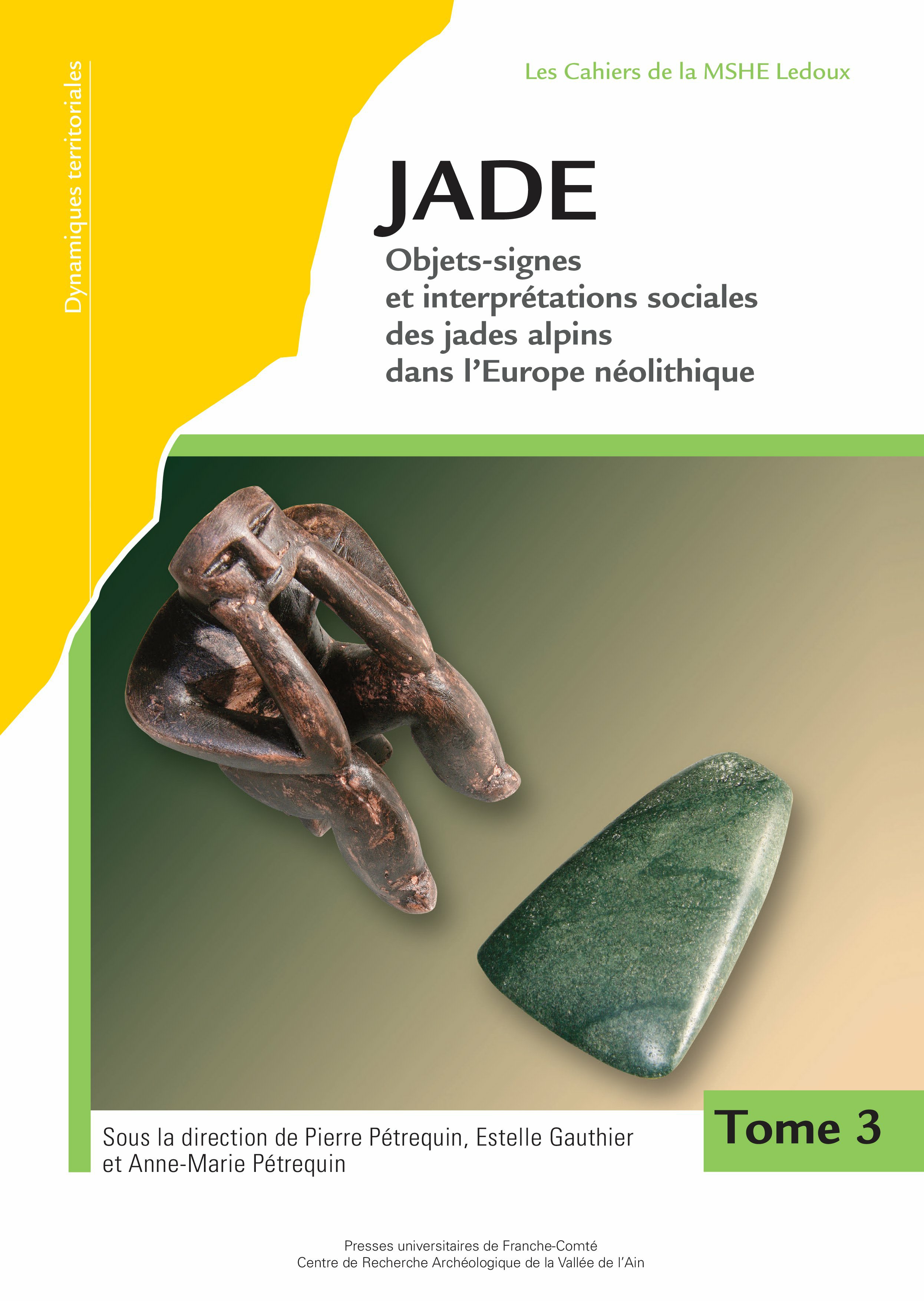
Download Url(s)
https://books.openedition.org/pufc/21232Contributor(s)
Pétrequin, Pierre (editor)
Gauthier, Estelle (editor)
Pétrequin, Anne-Marie (editor)
Language
FrenchAbstract
The concepts of exchange, circulation, and networks are currently particularly important issues in research on the European Neolithic.A previous ANR project, “JADE” (2006-2009), focused on polished axes made from Alpine jade (jadeite, omphacite, fine eclogite), which circulated in Western Europe during the 5th and 4th millennia BC. Spectacular transfers have been identified over distances of 1,700 km as the crow flies, from northern Italy to the Atlantic in the west and the Black Sea in the east. The picture that emerges from distribution maps and deposit contexts in Western Europe is one of highly unequal societies where trade was controlled by the powerful, with the manipulation of consecrated or sacrificed objects that touched on the realm of competition and social display, of course, but also religious rituals, mythology, and the ideal reproduction of summers.The new project, JADE 2 (2013-2017), also supported by the ANR, has been extended to the whole of Europe – from Ireland to Turkey and from Denmark to Malta – where jade transfers were supplied by two production centers: the Aegean island of Syros, where the oldest quarries date back to at least the end of the 7th millennium, and the Alpine massifs of Mount Beigua and Mount Viso, where production probably began around the middle of the 6th millennium.With a systematic inventory of jades and their context of deposit, particularly in Central Europe and the Balkans, this new project aims to shed light on the social values that underpinned the long-distance circulation of large axes (and, to a lesser extent, Alpine disc rings) in a complex network covering 3,200 km from east to west. The approach is based on a comparison between the ideal interpretations of the producers of jade tools and symbolic objects (Piedmont) and the social imagination of distant recipients on the margins of Europe.The study of the technical and social functions of polished Alpine jade blades, reinterpreted during transfers between the Atlantic and the Black Sea, further highlights the bipartition of Neolithic Europe during the 5th millennium, with two opposing systems of social values and religious conceptions, one based on Alpine jade and the other on copper and gold.The book also includes a comprehensive illustrated inventory of large Alpine jade axes (updated in 2016) and numerous maps showing the distribution of the most significant types.
Keywords
Axehead; Neolithic period; Jade; Ethnoarchaeology; Lithic toolsDOI
10.4000/15ftfWebshop link
https://www.7switch.com/fr/ebo ...ISBN
9782848677989, 9782848675756Publisher
Presses universitaires de Franche-ComtéPublisher website
http://books.openedition.org/pufcPublication date and place
Besançon, 2017Series
Les Cahiers de la MSHE Ledoux,Classification
Ancient history
European history
Archaeology
Pages
1468
Except where otherwise noted, this item's license is described
as
https://creativecommons.org/licenses/by-nc-nd/4.0/