
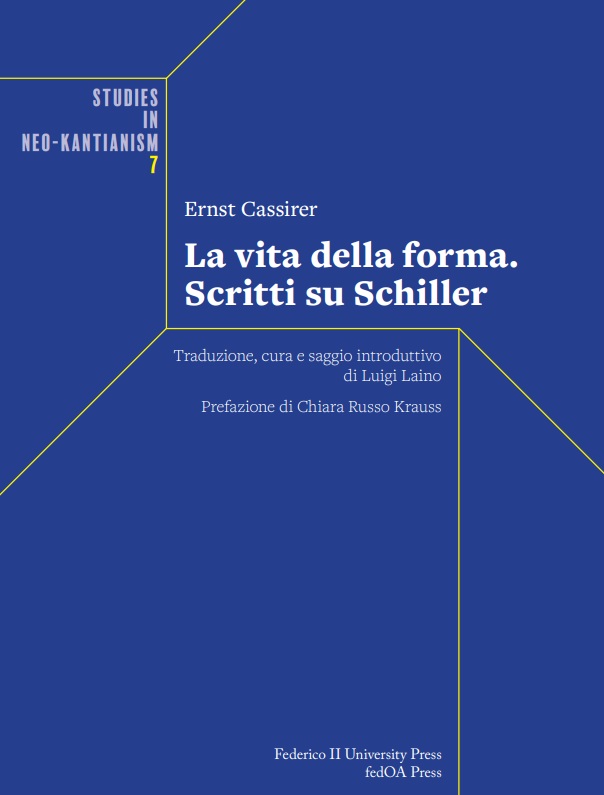
Ernst Cassirer : La vita della forma. Scritti su Schiller
Contributor(s)
Laino, Luigi (editor)
Russo Krauss, Chiara (editor)
Version
PublishedLanguage
ItalianAbstract
The volume presents, for the first time in Italian translation, three Cassirer essays devoted to Schiller—The Method of Idealism in Schiller’s Philosophical Writings (1921), Schiller’s Philosophical World‑View (a cycle of public lectures from the 1920/21 academic year), and Schiller and Shaftesbury (1935)—preceded by a Preface by Chiara Russo Krauss and an introductory essay by Luigi Laino that reconstructs their context, sources, and theoretical import. Conceived within the PRIN 2022 project “The Neo‑Kantian Reception of Schiller between Platonism and Kantianism,” the book documents the zenith of Schiller’s influence on the Marburg School. The underlying motif of Cassirer’s idealism is, in fact, closely bound to Schiller’s reworking of Kant’s transcendental philosophy, mediating between spontaneity and receptivity, spirit and nature. To know is always to give form to matter, and thus epistemology and aesthetics appear as two sides of the same coin. The volume’s title, which alludes to the “life of form,” captures this crucial intersection. Il volume presenta per la prima volta in traduzione italiana tre scritti cassireriani dedicati a Schiller – La metodica dell’idealismo negli scritti filosofici di Schiller (1921), La visione filosofica del mondo di Schiller (ciclo di lezioni pubbliche dell’anno accademico1920/21) e Schiller e Shaftesbury (1935) –, preceduti da una Prefazione di Chiara Russo Krauss e da un ampio saggio introduttivo di Luigi Laino che ne ricostruisce contesto, fonti e portato teorico. Il libro nasce nell’ambito del progetto PRIN 2022 “The neo-Kantian reception of Schiller between Platonism and Kantianism” e documenta l’apice dell’influenza schilleriana sulla scuola di Marburgo. Il motivo di fondo dell’idealismo di Cassirer, infatti, è strettamente legato alla rielaborazione cui Schiller sottopone la filosofia trascendentale di Kant, mediando tra spontaneità e ricettività, spirito e natura. Conoscere è sempre dare forma alla materia, e così teoria della conoscenza ed estetica appaiono essere due facce della stessa medaglia. Il titolo del volume, che allude alla “vita della forma”, rende conto di questa cruciale intersezione.
Keywords
Neokantismo, Forme simboliche, Epistemologia, Estetica, EticaISBN
978-88-6887-388-2Publisher
FedOA - Federico II University PressPublisher website
http://www.fedoabooks.unina.it/index.php/fedoapressPublication date and place
Naples, 2026Series
Studies in Neo-Kantianism, 7Classification
Philosophy
Pages
183
Except where otherwise noted, this item's license is described
as
https://creativecommons.org/licenses/by-nc-nd/4.0/