
La monarquía franquista
Discursos doctrinales y legislativos
Version
PublishedLanguage
SpanishAbstract
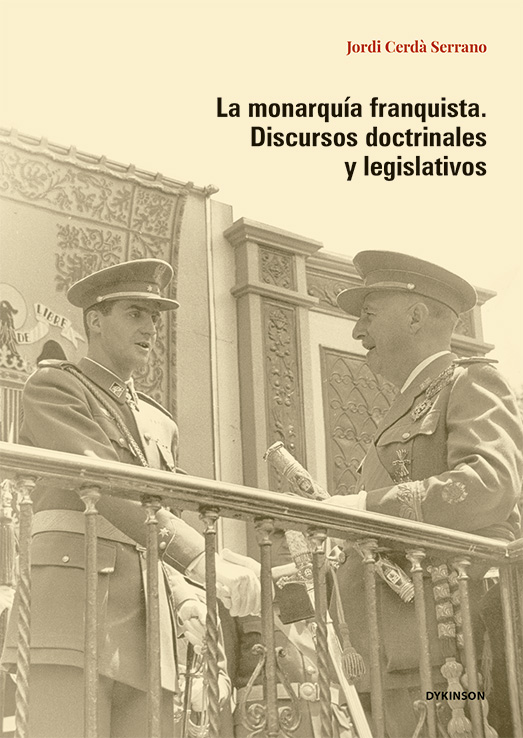
This book addresses how the monarchy that formally created the Law of Succession to the Head of State in 1947 had little institutionalising potential for a dictatorship without Franco, but much in the way of legitimising the ideological foundations of Franco's state. This legitimising function of the monarchy is reflected in legal and political discourse from the beginning of the dictatorship, in the midst of the civil war, until the approval of the Law of Succession. The main themes evoked in these discourses were the Spanish nation (one, Catholic and imperial) and a genuine representative system that validated the corporatism of the dictatorship, as well as its anti-democratic and anti-liberal narratives. Over the years, that same monarchy would be redefined and become a powerful institution for safeguarding the continuity of the regime founded on 18 July. In turn, in the process of drafting the Law of Succession in Franco's Cortes, it is clear that what was important to the attorneys was not to institutionalise the monarchy that would succeed Franco, but rather the caudillismo itself and, ultimately, the articulation of power in the dictatorship. The starting point for the Law of Succession and its monarchy was not normativity, but the political and symbolic use of the law. Este libro aborda cómo la monarquía que formalmente creó la Ley de Sucesión en la Jefatura del Estado en 1947 tenía poco de horizonte institucionalizador para una dictadura sin Franco, pero mucho de narrativa legitimadora de los fundamentos ideológicos del Estado franquista. Esta función legitimadora de la monarquía queda plasmada en discursos jurídicos y políticos desde el inicio de la dictadura, en plena guerra civil, hasta la aprobación de la Ley de Sucesión. Los principales ejes evocativos en estos discursos fueron la nación española (una, católica e imperial) y un sistema representativo genuino que validaba el corporativismo de la dictadura, así como sus narrativas antidemocráticas y antiliberales. Esa misma monarquía, con los años, se resignificaría y devendría una institución en potencia para salvaguardar la continuidad del régimen fundado en el 18 de julio. A su vez, en el procedimiento de elaboración de la Ley de Sucesión en las Cortes franquistas, se constata que lo importante para los procuradores no era institucionalizar la monarquía sucesora de Franco, sino el propio caudillaje y, en última instancia, la articulación del poder en la dictadura. El punto de partida de la Ley de Sucesión y de su monarquía no fue la normatividad, sino el uso político y simbólico del derecho.
Keywords
Franquismo; Monarquía; MonarchyWebshop link
https://www.dykinson.com/libro ...ISBN
979-13-7006-819-6Publisher website
https://www.uc3m.es/figuerola-institute/homePublication date and place
Madrid, 2025Imprint
DykinsonSeries
Historia del Derecho, 144Classification
Law
History
Pages
399
Except where otherwise noted, this item's license is described
as
https://creativecommons.org/licenses/by-nc-nd/4.0/