
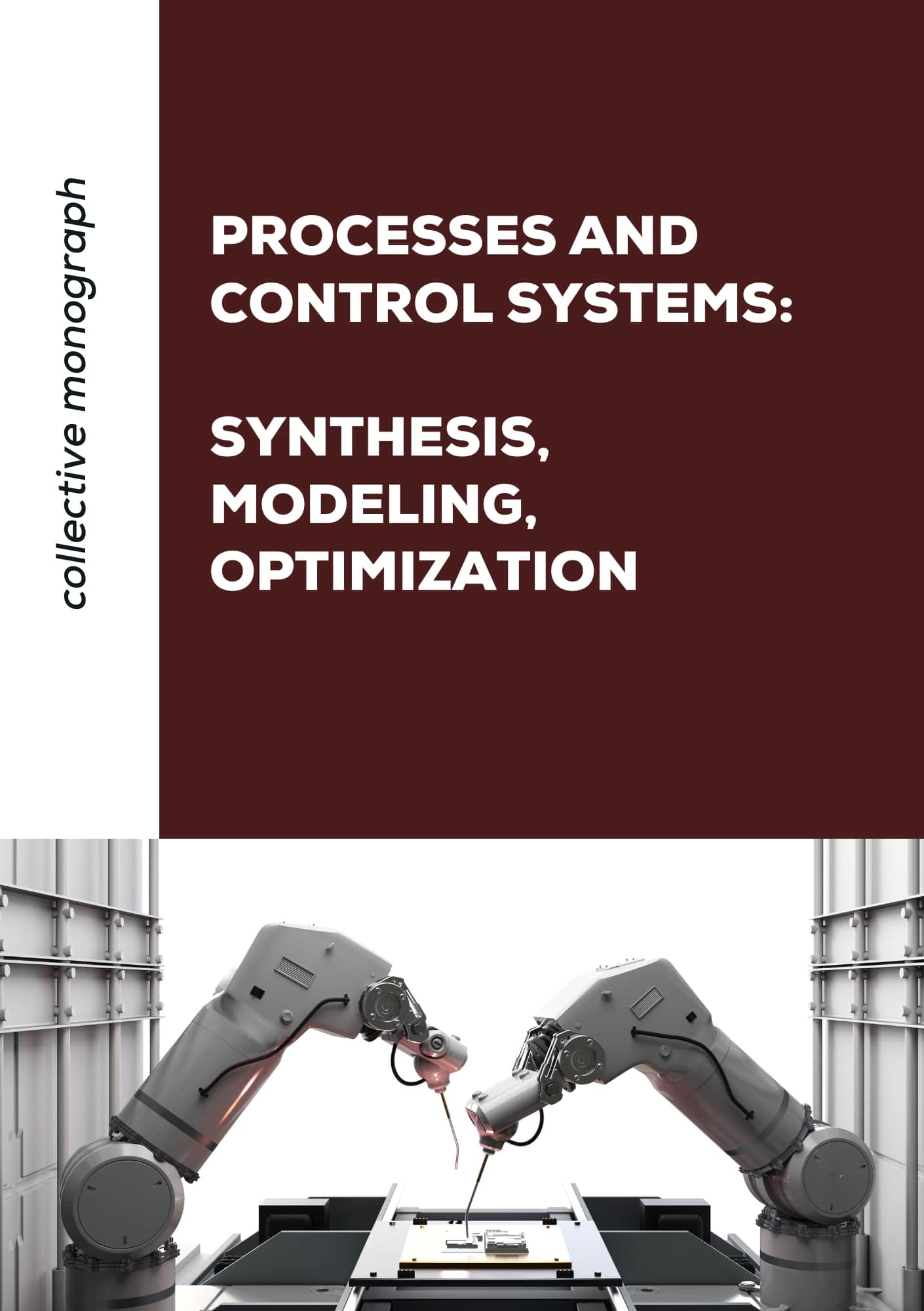
PROCESSES AND CONTROL SYSTEMS: SYNTHESIS, MODELING, OPTIMIZATION
Download Url(s)
https://monograph.com.ua/catalog/book/978-617-8360-19-1Contributor(s)
Krasnikov, Igor (editor)
Version
PublishedLanguage
EnglishAbstract
The collective monograph focuses on the study of modeling methods, analytical assessment and optimization of complex technical systems in industry and energy. The presented materials cover the tasks of heat transfer, operational reliability, mobile control, distributed energy and predictive monitoring, forming a holistic scientific and applied basis for the implementation of engineering solutions in real production conditions. The monograph is aimed at systematizing methods that ensure increased efficiency of technological facilities through mathematical analysis, digital measurements and adaptive control.
The first section examines in detail the processes of secondary condensation in large-capacity ammonia synthesis units of the AM-1360 type. Special attention is paid to methods for experimental identification of thermophysical parameters that determine the operation of heat exchangers in unsteady modes. Refined mathematical models of heat transfer have been constructed and the influence of structural deviations on energy consumption parameters has been assessed. It is shown that the use of adaptive software control allows to adjust temperature profiles, reduce the load on refrigeration units and increase the resource of heat engineering equipment. The presented results can be taken into account during the modernization of technological lines of the chemical industry.
The second section is devoted to the analysis of the operational reliability of transport systems based on large sets of statistical data. A methodology for detecting latent deviations and "repeated anomalies" that are not recorded by standard control means is proposed. An assessment of negative statistics and time trends is carried out, which allow to establish potential areas of infrastructure degradation. The feasibility of the transition from reactive maintenance to preventive management is substantiated, when decisions are based not on the fact of failure, but on early signs of its occurrence. This approach creates the basis for the implementation of predictive diagnostics systems in transport.
The third section considers the issue of optimal regulation of azimuthal power plants of marine vessels. Based on parametric modeling, the influence of external disturbances and variable loads on the behavior of the ship complex was investigated. Adaptive controller structures were developed that ensure course stability, reduce energy consumption, and increase the accuracy of maneuvering operations. Criteria for selecting control laws for operating conditions where traditional PID methods lose their effectiveness were outlined. The results confirm the possibility of integrating new-type controllers into ship motion systems.
The fourth section is devoted to the architecture of autonomous microgrid-class electric power systems. The principles of coordination between generation, storage, and consumption of electricity using multi-agent subsystems are considered. Mechanisms for maintaining stability in the event of loss of connection to the centralized network are substantiated, and the issue of load balancing in abnormal modes is also considered. The presented models demonstrate the possibility of forming a flexible energy infrastructure capable of providing guaranteed power supply to technological equipment without involving dispatch control.
The fifth section presents approaches to predictive maintenance of metallurgical equipment using the example of the lining of induction crucible furnaces. The technology of 3D laser profiling is proposed for spatial reconstruction of the inner surface of the lining and determination of zones of marginal wear. Criteria for permissible deviation of geometry are established and a methodology for calculating the residual resource of the lining layer is developed. Practical results confirm that the transition to condition-based monitoring allows to reduce emergency downtime and economic losses associated with the destruction of working units. The summarized results of the monograph can be used during the design, adjustment and operation of automation systems, energy facilities and industrial units. The presented methods create the basis for the development of integrated control systems in which mathematical modeling is combined with digital monitoring and preventive intervention. The materials of the publication constitute a scientific contribution to the development of engineering practice, focused on increasing technological reliability and optimizing the life cycle of technical systems.
Keywords
ammonia production; secondary condensation; mathematical modelling of heat transfer processes; computer-integrated technology; software control; processes and control systems; modeling systems; railway transport; transport technologies; transport process management; tolerance; statistical regularity; norm of behavior of the system "bottleneck"; combined propulsion complex; thruster; linear-quadratic control; modeling; local electrical systems; autonomous mode; renewable energy sources; intelligent control system; induction crucible melting; refractory wear mechanisms; furnace lining durability; 3D laser scanning systems; automated condition monitoring; continuous improvement methodology; digital profiling technologies; triz methodology; morphological analysis; method of control questions; method of focal objects; theory of inventive problem solving; functional–value analysis; slag formation optimisation; crucible geometry adjustment; cooling regime improvementISBN
978-617-8360-19-1Publisher
PC TECHNOLOGY CENTERPublisher website
https://entc.com.ua/en/Publication date and place
Kharkiv. Ukraine, 2025-11-11Classification
Technology, Engineering, Agriculture, Industrial processes
Pages
196
Except where otherwise noted, this item's license is described
as
https://creativecommons.org/licenses/by-nc-nd/4.0/