
Devil's Oak
Waking the Feminine Wound
Download Url(s)
https://doi.org/10.56638/mtopb00425Contributor(s)
A.Miller (editor)
A. Miller (illustrator)
Christopher Barzak (other)
Version
PublishedLanguage
EnglishAbstract
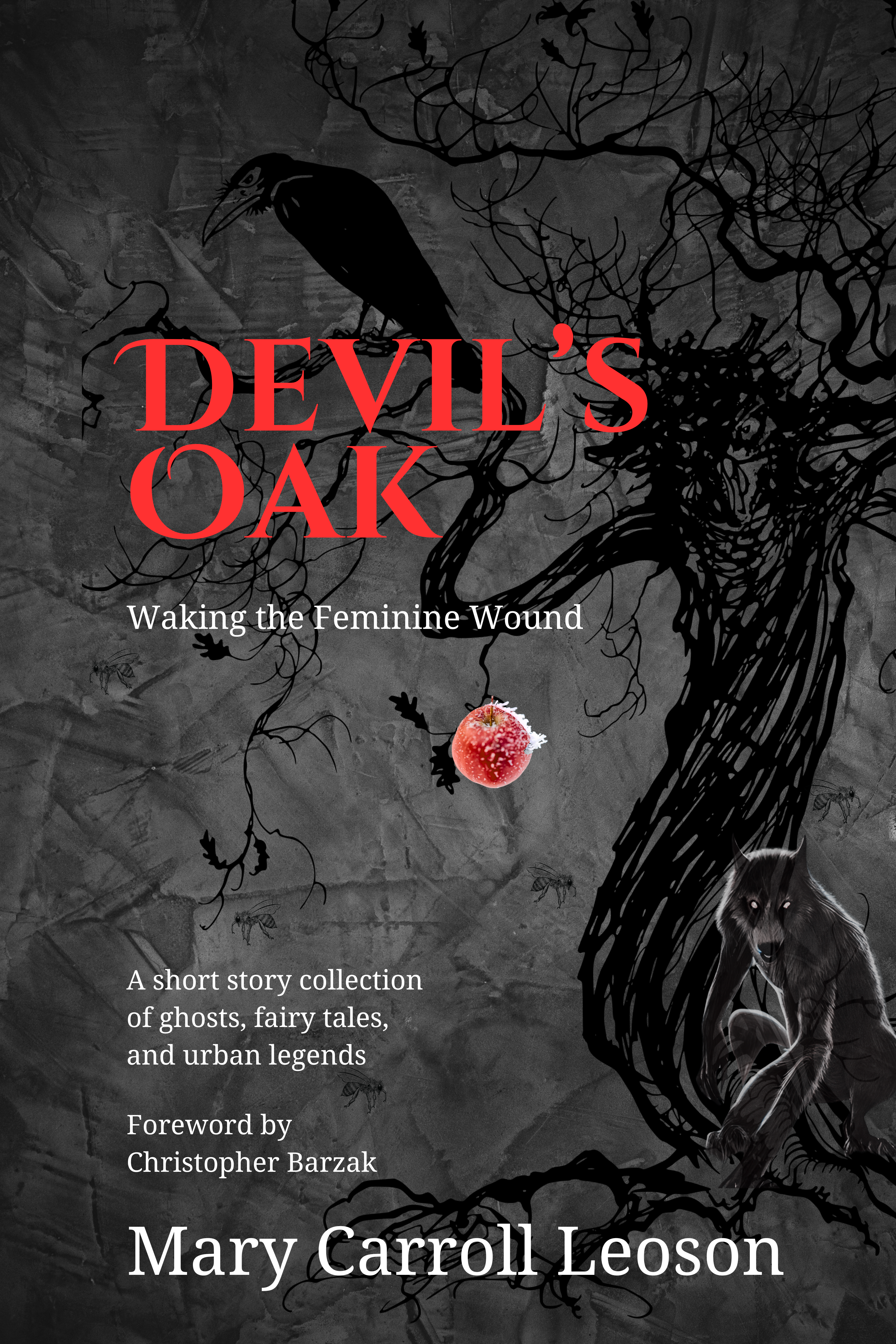
Devil’s Oak: Waking the Feminine Wound is a short story collection that features strong female characters against a backdrop of ghosts, fairy tales, and urban legends. The thirteen stories subvert the historical narrative of women in fairy tales, positioning them as bold and willing to step into the face of danger. “The Braided Veil” features a young orphan in Victorian New Orleans who seeks revenge upon her mother’s abuser. “Devil’s Oak” addresses the horrors of slavery through the eyes of a young girl who learns that her family owned human beings. “Good Little Girls” takes readers back to childhood in which a sick girl explores her neighbor’s attic on a stormy day; she discovers more than she bargained for. “The Game” features relational aggression in the 1990’s in a “mean girls” style that takes a grizzly turn. “Selkie Skin” leans into Celtic lore, following a young pregnant girl who longs for freedom. “The Ripper Society” reaches back through time to Jack the Ripper’s wife, who discovers his misdeeds and takes matters into her own hands. “She Has Seen the Wolf” is longer story that connects to my novel, The Butterfly Circle; when a graduate student learns she is pregnant, she uncovers her family’s connected history to a haunted home for unwed mothers. In “Roots in the Cove,” a woman in an unhealthy relationship shapeshifts into a bear on a trip to Gatlinburg and finally finds her freedom. Both “Marsh Girl” and “Cicadas in the Suburbs” explore the psychological challenges of suburban life, including postpartum depression and the longing for the magic of youth. In “Honey Tree,” a divorced woman seeks comfort from the bees, and in “Crow Woman,” a widow faces metaphorical death and is reborn. Finally, “Ghost Apples” is a retelling of Snow White from the perspective of the queen; she shapeshifts into a wolf to protect a young girl who has been attacked and seeks revenge upon her abuser.
----The academic role of this book: This collection has been developed with two primary audiences in mind—genre readers and students of creative writing and literature. As a Lecturer in the English Department at Middle Tennessee State University (MTSU), I am privileged to teach courses in creative writing and themed literature classes, such as “ghosts and folklore” and “gothic and horror.” The Devil’s Oak collection is one optional text for both ENGL 2500 Introduction to Creative Writing and ENGL 2020 Themes in Literature and Culture. In creative writing courses, students examine focal texts (specifically short story collections) that demonstrate skillful use of literary elements; these exemplars serve as inspiration for students to find their own voices as writers. Students choose their focal texts as well as specific theoretical lenses through which they examine literature. After reading their chosen focal texts, they work alone or in groups to develop academic essays, oral presentations, and multimodal artifacts illustrating their insights and arguments. I hope that literature students who choose the Devil’s Oak collection as a focal text find the stories to be compelling and relevant to today’s society, even those stories that are historical in nature. Additionally, for creative writing students who choose the text, I hope that they are inspired to develop their own characters who are deeply rooted in active setting. With each story they write, I hope they find new layers of their own unique voices.
----For all readers (genre readers and creative writing students): Horror stories can be both genre and literary in nature, and they often address wounds that need to be healed within individuals, communities, and greater society. Dark fiction is a safe space to explore such emotions. My approach to writing horror is a braiding of magical realism, hauntings, and darker versions of well-known fairy tales. These tendrils of story reach past the boundary of the expected, leading readers into Freud’s notion of the uncanny and Kristeva’s abject horror. Ghost stories specifically can break the rules of reality and move a story beyond the here and now into the unknown, where individual and collective healing can happen at both the conscious and unconscious levels of psyche. I invite you to walk with me in this liminal space. I believe storytelling is crucial to teaching, to connecting with others, and to healing individual and collective wounds. I have found such healing particularly through writing historical fiction that weaves fairy tales, ghost stories, and a combination of darkness and light.
Keywords
creative writing; education; literature; literary horror; magical realism; short story collectionWebshop link
https://www.lulu.com/spotlight/mtopISBN
979-8-9995864-0-7, 979-8-9871721-9-3, 979-8-9871721-6-2, 979-8-9871721-7-9Publisher website
https://openpress.mtsu.eduPublication date and place
https://openpress.mtsu.edu, 2025-10Imprint
MT Open Press, Middle Tennessee State UniversitySeries
Blue Crescent Books,Classification
Fiction: Traditional stories, myths and fairy tales
Literary studies: fiction, novelists and prose writers
Relating to the stages of life
Short stories
Pages
178 (digital pdf); 300 (paperback); also available in epub
Except where otherwise noted, this item's license is described
as
https://creativecommons.org/licenses/by-nc-nd/4.0/