
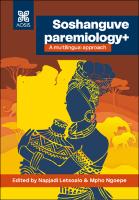
Soshanguve paremiology+
A multilingual approach
Contributor(s)
Letsoalo, Napjadi (editor)
Ngoepe, Mpho (editor)
Language
EnglishAbstract
This scholarly book explores the transformative role of proverbs in cultural education, preservation and scholarly discourse in South Africa. It emphasises the importance of integrating indigenous African knowledge into academic spaces to support decolonisation, (re)Africanisation and transformation. Proverbs are presented as tools for promoting multilingualism, multiculturalism, social cohesion and mutual respect in South Africa's diverse society. The book addresses the United Nations' (UN) Sustainable Development Goal (SDG) 4 (quality education), SDG 5 (gender equity), SDG 9 (innovation) and SDG 10 (reduce inequality). It serves as a teaching resource for proverbs in Northern Sotho/Sepedi, Sesotho, Setswana, Xitsonga, isiZulu, isiXhosa, isiNdebele, siSwati and/or Tshivenḓa (Sotho, Shangaan, Nguni and Venḓa, i.e. Soshanguve), as well as Chichewa and Shona, supporting cross-cultural understanding. Grounded in a scholarly project on a multilingual proverbs dictionary, the book applies theoretical frameworks such as conceptual metaphor theory, ethnopragmatics and translation quality assessment to analyse proverbs. This interdisciplinary approach bridges linguistics, anthropology and digital humanities, offering fresh insights into the semantics and cultural significance of proverbs. The chapters in the book explore themes like proverbs in music, their intersection with patriarchy, and translation quality assessment. Targeted at scholars and experts in languages, literature, linguistics and digital humanities, the book advances the study of proverbs while fostering cultural awareness and sensitivity. It highlights the value of proverbs as linguistic and cultural assets, enriching academic and practical applications across disciplines.
Keywords
African languages; African literature; African proverbs; anthropology; Chichewa; conceptual metaphor theory; conditional proverb; cultural awareness; declarative proverb; dictionary; digital humanities; English translation; ethnopragmatics; fixed expressions; functional-pragmatic model; House’s model of quality assessment; indigenous knowledge; indigenous knowledge system; indigeneous languages oral history technology; imperative proverb; isiXhosa; isiZulu; multilingual proverbs; multilingual proverbs dictionary; multilingualism; multicultural; Northern Sotho; observe/reflect model; official languages; paremiology; paremiology curriculum; proverb analysis; proverbial expressions; proverbs; proverbs teaching; quality education; reduced inequalities; semantics; semantically closed expressions; Sesotho sa Leboa; Setswana; Shona; siSwati; social justice; Soshanguvel linguistics; Sotho; South African linguistic communities; syntax; technology; translation quality assessment; Tshivenda; universal truths; XitsongaISBN
9781779953520, 9781779953513, 9781779953506, 9781779953742Publisher
AOSISPublisher website
http://www.aosis.co.zaPublication date and place
Cape Town, 2025Imprint
AOSIS BooksClassification
Sociolinguistics
Pages
240
Except where otherwise noted, this item's license is described
as
open access