
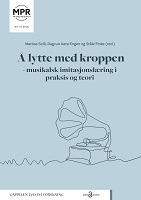
Å lytte med kroppen
musikalsk imitasjonslæring i praksis og teori
Download Url(s)
https://library.oapen.org/bitstream/20.500.12657/105087/1/%c3%85_lytte_med_kroppen.pdfContributor(s)
Solli, Mattias (editor)
Aarø Engen, Dagrun Astrid (editor)
Fink, Ståle (editor)
Language
English; Norwegian Nynorsk; Norwegian BokmålAbstract
How do we learn to make music, to sing and play — alone or together with others? This anthology explores the question through practices that center on musical imitation-based learning. It highlights the value of learning music ""by ear"" — through active listening and with the body as the primary instrument. The chapters are written by musicians, educators, musicologists, pedagogues, and philosophers who share an interest in imitation-based learning and musical understanding across genres, traditions, and institutions. Drawing on recent research into pedagogical aspects of musicality development and creative interplay, the authors discuss:
- the role of aural imitation in higher education, and its potential influence on learning environment, artistic research, and policy-making;
- how teachers and music pedagogy students can engage younger learners with aural imitation in municipal music schools and through genre-transcending methods;
- how Sub-Saharan African traditions emphasize embodied, interactive musicking and imitation as pathways to shared musical flow states;
- how early imitation and rhythmic learning foster potent and open-ended musical learning later in life, as well as musical identities and communal bonds;
- how an emphasis on aural imitation indirectly offers critical perspectives on ‘aesthetic learning processes’ in primary and secondary education;
- and how different theoretical models of aural imitation can both reveal and obscure understandings of musicality as communicative, embodied, rhythmic, and relational practice.
The book also includes an instructive pedagogical text and a QR code linking to a video demonstrating how to learn music through imitation. Hvordan lærer vi å musisere, spille og synge – alene eller sammen med andre? Denne antologien utforsker spørsmålet med utgangspunkt i praksiser der musikalsk imitasjonslæring står i sentrum. Her vektlegges verdien av å lære musikk «på øret» – gjennom aktiv lytting og med kroppen som det viktigste instrumentet.
Bidragene springer ut fra erfaringer ved NTNU Jazzlinja, og er skrevet av musikere, pedagoger, musikkvitere og filosofer med en felles interesse for imitasjonslæring og musikalsk forståelse på tvers av sjangre, tradisjoner og institusjoner. Tekstene er basert på nyere forskning på pedagogiske aspekter ved musikalitetsutvikling og kreativt samspill. Boken inneholder også med en QR-kode som gir tilgang til en video som illustrerer hvordan å lære musikk gjennom imitasjon.
Keywords
aural imitation method, didactic design theory, musikalsk imitasjon, imitasjonslæring, planking, gehørbasert metodikk, estetiske læringsprosesserDOI
10.23865/cdf.257Publisher website
http://press.nordicopenaccess.noPublication date and place
Oslo, 2025Grantor
Series
MusPed:Research,Classification
Theory of music and musicology
Techniques of music / music tutorials / teaching of music
Education
Teaching skills and techniques
Pages
287
Except where otherwise noted, this item's license is described
as
open access