
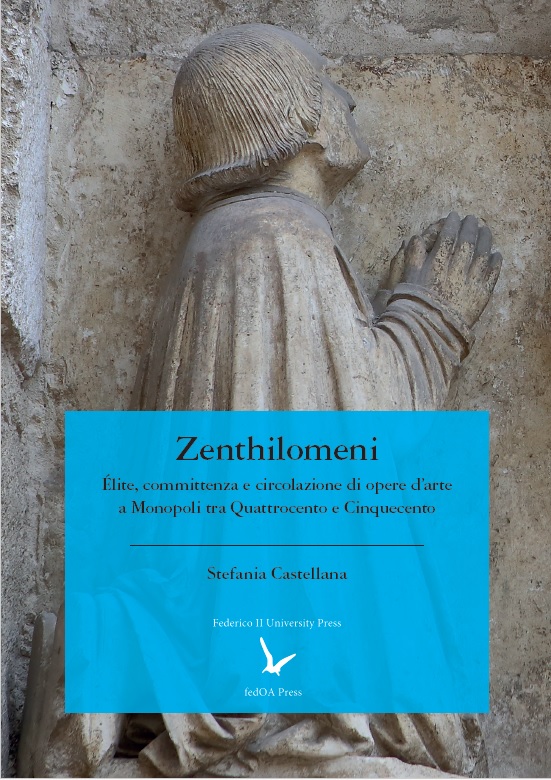
Zenthilomeni. Élite, patronage and circulation of artworks in Monopoli between the Fifteenth and the Sixteenth Centuries
Version
PublishedLanguage
ItalianAbstract
Within the broader context of Apulian towns characterized by a widespread presence of Venetian artworks, Monopoli stands out as a true ‘case study’ due to the significant commissions – traced by scholarship to figures belonging to the local élite – bestowed upon the two leading masters active in Venice between the Fifteenth and Sixteenth Centuries: St. Jerome in His Study by Lazzaro Bastiani and St. Peter Martyr by Giovanni Bellini. The artistic landscape of Monopoli, typically associated with its political subjugation to the Serenissima around the turn of the century and often interpreted as an expression of cultural subordination, is here reconsidered in light of the most recent studies on the Renaissance in Southern Italy. These studies have emphasized its polycentric urban dimension, which, combined with an in-depth investigation of the élite and the attitudes of the so-called zenthilomeni toward the arts, provides a renewed framework for analysis. This volume focuses on the circulation of artworks reflecting a typical Venetian taste, as well as on the artists and patrons active in Monopoli, adopting an approach attentive to both political and social dimensions. A critical reassessment of published sources and archival materials, combined with a relational approach to the study of family networks – particularly the Arpona, Palmieri, Montemaro, and Ferro families – the spatial ‘geography’ of sacred space occupation, and a particular focus on prominent figures active both within and beyond the Kingdom, has allowed for the proposal of original scenarios concerning the circulation, chronology, and style of Venetian artworks in the area. This includes examining the role of intermediaries, the involvement of masters, and the aesthetic preferences of Monopoli’s society, ultimately opening new perspectives for re-evaluating the broader phenomenon of artistic importation from Venice to Apulia. Nel panorama che vede i centri pugliesi interessati da una capillare presenza di opere d’arte venete, Monopoli si presenta come un vero e proprio ‘caso’ per via delle importanti commissioni – ricondotte dagli studi a personalità facenti capo all’élite cittadina – ai due principali maestri attivi a Venezia tra Quattrocento e Cinquecento: il San Gerolamo nello studio di Lazzaro Bastiani e il San Pietro martire di Giovanni Bellini. La situazione artistica di Monopoli, generalmente connessa alla sottomissione alla Serenissima negli anni a cavallo tra i due secoli e sovente interpretata come manifestazione di subalternità culturale, viene qui analizzata alla luce dei più recenti studi sul Rinascimento in Italia meridionale, che ne hanno messo in evidenza la dimensione urbana policentrica, e attraverso un approfondimento sull’élite e sull’atteggiamento dei cosiddetti zenthilomeni nei confronti delle arti. Il volume si concentra sulla circolazione di opere di gusto lagunare, e sugli artisti e committenti presenti in città, affrontando l’argomento con approccio attento alla dimensione politica e sociale. La rilettura di fonti edite e del materiale archivistico, l’approccio relazionale nello studio dei legami tra le famiglie – su tutte Arpona, Palmieri, Montemaro, Ferro –, della ‘geografia’ dell’occupazione dello spazio sacro e il focus su alcune personalità di spicco attive sia dentro che fuori dal Regno, hanno consentito di proporre scenari originali relativi alla circolazione, alla cronologia e allo stile delle opere venete presenti sul territorio, al ruolo dei mediatori, al coinvolgimento dei maestri e al gusto della società monopolitana, aprendo nuove prospettive per riconsiderare il più ampio fenomeno dell’importazione artistica da Venezia alla Puglia.
Keywords
Monopoli, Venice, Renaissance in Southern Italy, Patronage, Circulation of artworksPublisher
FedOA - Federico II University PressPublisher website
http://www.fedoabooks.unina.it/index.php/fedoapressPublication date and place
Naples, 2025-06-24Series
Regna, 11Classification
History and Archaeology
Pages
202
Except where otherwise noted, this item's license is described
as
https://creativecommons.org/licenses/by-nc-nd/4.0/