
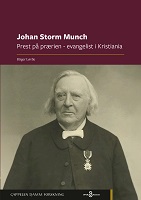
Johan Storm Munch
Prest på prærien – evangelist i Kristiania
Language
Norwegian BokmålAbstract
Johan Storm Munch's life (1827–1908) was an encounter with most of the changes that Norwegian church life was exposed to in the 19th century. In this book, you can follow him from his early years in Kristiansand, where his father was bishop, and on to his life as a student in Kristiania. He came to live in a time of great spiritual renewal. As a student, Johan Storm Munch seems to have been influenced by the spirituality of the Moravian Brethren. As a pastor for Norwegian emigrants in the United States, Storm Munch got to know a church life that was both Lutheran and independent from national authorities. During the years he spent in America he also strengthened his relationship to the Haugean movement that had formed one of the Norwegian church bodies there.
When Johan Storm Munch became a student, his mother was widowed, and he had to finance his theological education by working as a schoolteacher. And it was as teacher he met the woman that should become his wife, Kaja Falch. Her letters from the time in the United States are an important source of knowledge about life among the emigrants, in addition to providing a picture of a creative and committed woman.
When Johan Storm Munch returned to Norway, he became a staunch advocate for freedom for the state church. He gave up his ministry in 1875 and moved to the capital with his family. There he worked as an evangelist with the American preacher Moody as his role model, while the most famous songs from Moody's Associates were translated into Norwegian. Who has not sung ""I Will Sing of My Redeemer"" and ""What a Friend we Have in Jesus""? His preaching in the Klingenberg Dance Hall and the Calmeyergaten Mission House often gathered over 2,000 listeners, and he published several books. He was also active as an advisor to those who founded the Evangelical Lutheran Free Church of Norway, in Arendal 1877. In 1901, Johan Storm Munch was knighted by King Oscar of Norway for ""meritorious pastoral work."" Johan Storm Munchs liv ble et møte med de fleste endringene som norsk kirkeliv ble utsatt for på 1800-tallet; ei tid sterkt preget av vekkelse. Munch ble født og vokste opp i Kristiansand, der hans far var biskop, men faren døde tidlig. Johan måtte finansiere presteutdanningen med arbeid som lærer. Slik møtte han sin framtidige kone, Kaja Falch. I studietida stiftet han også varig bekjentskap med den tyske brødremenigheten.
Ekteparet Munch dro til USA, og som prest for norske utvandrere møtte Johan et kirkeliv som var samtidig luthersk og frikirkelig. Gjennom en av de norske synodene lærte han også Hauge-bevegelsen å kjenne. Kajas brev fra tida i USA er en viktig kilde til kunnskap om livet blant utvandrerne, i tillegg til at de gir et bilde av en kreativ og engasjert kvinne.
Da Johan Storm Munch kom tilbake til Norge ble han en iherdig forkjemper for større frihet for kirken. Han gav opp å være prest i 1875 og flyttet til hovedstaden med sin familie for å virke som evangelist med den amerikanske predikanten Moody som forbilde. Møtene Munch holdt samlet ofte over to tusen tilhørere. Han var også aktiv som rådgiver for stifterne av Den Evangelisk Lutherske Frikirke i Arendal i 1877, og ble i 1901 slått til ridder av St. Olavs Orden for «fortjenstfullt geistlig arbeid».
Keywords
church life, cross-culturalism, evangelization, Evangelical Lutheran Free Church of Norway, state church, Johan Storm Munch, kirkeliv, prest, Den Evangeliske Lutherske FrikirkeDOI
10.23865/cdf.245ISBN
9788202874094, 9788202883478, 9788202883492, 9788202883485Publisher website
http://press.nordicopenaccess.noPublication date and place
Oslo, 2025Grantor
Classification
Religious and theocratic ideologies
History of religion
Biography: religious and spiritual
Pages
315
Except where otherwise noted, this item's license is described
as
open access