
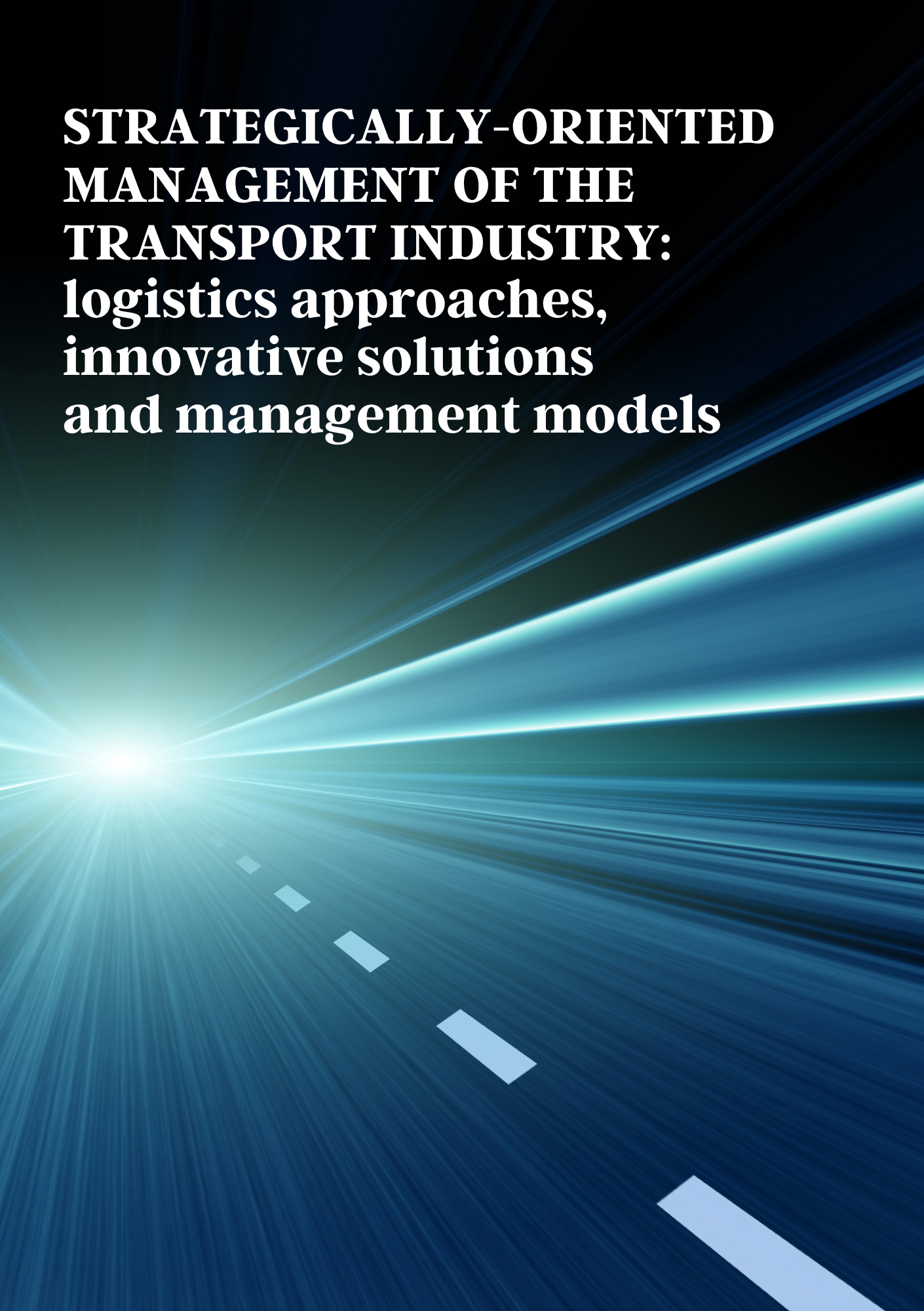
STRATEGIC-ORIENTED MANAGEMENT OF THE TRANSPORT INDUSTRY: LOGISTICS APPROACHES, INNOVATIVE SOLUTIONS AND MANAGEMENT MODELS
Download Url(s)
https://monograph.com.ua/catalog/book/978-617-8360-14-6Contributor(s)
Dmytriiev, Illia (editor)
Version
PublishedLanguage
EnglishAbstract
The study covers a range of problems related to risk management, logistics, enterprise relocation, transport infrastructure and sustainable development of transport enterprises, especially in conditions of military threats. It is determined that modern trends in risk management demonstrate significant progress with the expansion of its boundaries by introducing new concepts such as risk management, risk economics, risk engineering, risk administration and risk production. New professional approaches to risk classification are proposed, and the elements of risk content – certainty and uncertainty, taking into account their limiting values – are specified. It is proven that the erroneous perception of complete certainty or complete uncertainty in management processes is a factor that reduces the effectiveness of organizational decisions. The illusion of complete certainty leads to excessive bureaucratization and loss of adaptability, while the idea of complete uncertainty stimulates impulsive, unfounded decisions without proper analysis and forecasting. The elimination of such illusions allows the formation of adaptive management strategies that are able to respond more effectively to changes in the external environment.
To assess the readiness of enterprises for development, a two-component methodological approach is proposed, based on the analysis of investment adequacy and the balance of activity costs. An integral indicator of investment adequacy is determined, which allows assessing the resource capacity of enterprises. The testing of the approach at Ukrainian motor transport enterprises showed a low level of this indicator – a value in the range of 1.2–1.7 with a standard of 3 indicates limited resources for economic development and the dominance of survival strategies instead of development.
An analysis of the transport industry of Ukraine showed a significant deterioration in its indicators due to military aggression. In particular, the number of operating business entities, the volume of products sold and the level of profitability of enterprises decreased. The main problems of the industry are identified: disruption of transport chains, resource shortages, destruction of infrastructure and a decrease in the solvency of the population. In this regard, the need for the implementation of anti-crisis management is substantiated, which involves four consecutive stages: diagnostics of the state of the enterprise, development of an anti-crisis strategy, implementation of stabilization measures and methods and assessment of the effectiveness of these measures. Particular attention is paid to the adaptation of anti-crisis management to the conditions of the war period.
The problems of relocation of high-tech enterprises under martial law are studied. Logistics planning models are proposed that take into account the risks caused by military actions and disruption of transport corridors. The key stages of relocation are identified: selection of a safe location, adaptation of logistics infrastructure, establishment of new supply channels. Particular attention is paid to optimizing the supply of components at the new location of the enterprise, which is an important factor in maintaining competitiveness and sustainability of production.
The study considers the role of transport infrastructure in ensuring regional economic development. It is emphasized that transport facilities can have both positive and negative impacts on the regional economy. On the one hand, they contribute to the development of material flows and business activity, and on the other hand, they can stimulate population outflow and cause uneven development. The introduction of innovative transport infrastructure management mechanisms is proposed to ensure sustainable economic growth of regions.
Particular attention is paid to the sustainable development of passenger transport enterprises. A set of measures is proposed to financially support transport enterprises taking into account the principles of sustainable development. It is shown that investing in the modernization of vehicles, process automation and environmentally friendly technologies will contribute not only to reducing costs, but also to improving the quality of services and minimizing the negative impact on the environment.
An important aspect is the improvement of the route network and optimization of bus schedules. The need for integration of various types of public transport, the use of monitoring and dispatching information systems for prompt adjustment of routes in accordance with changes in demand is identified.
The obtained research results can be used both at the level of individual transport enterprises and for the formation of state transport policy. The proposed approaches will contribute to increasing the stability of the transport system, ensuring the effective functioning of logistics processes and sustainable development of the country's economy in the face of modern challenges.
Keywords
Risk management; logistics; relocation of enterprises; transport infrastructure; sustainable development; anti-crisis management; military threats; supply optimization; regional development; organization; logistics providerISBN
978-617-8360-14-6Publisher
PC TECHNOLOGY CENTERPublisher website
https://entc.com.ua/en/Publication date and place
Kharkiv. Ukraine, 2025-03-31Classification
Economics, Finance, Business and Management
Pages
104
Except where otherwise noted, this item's license is described
as
https://creativecommons.org/licenses/by-nc-nd/4.0/