
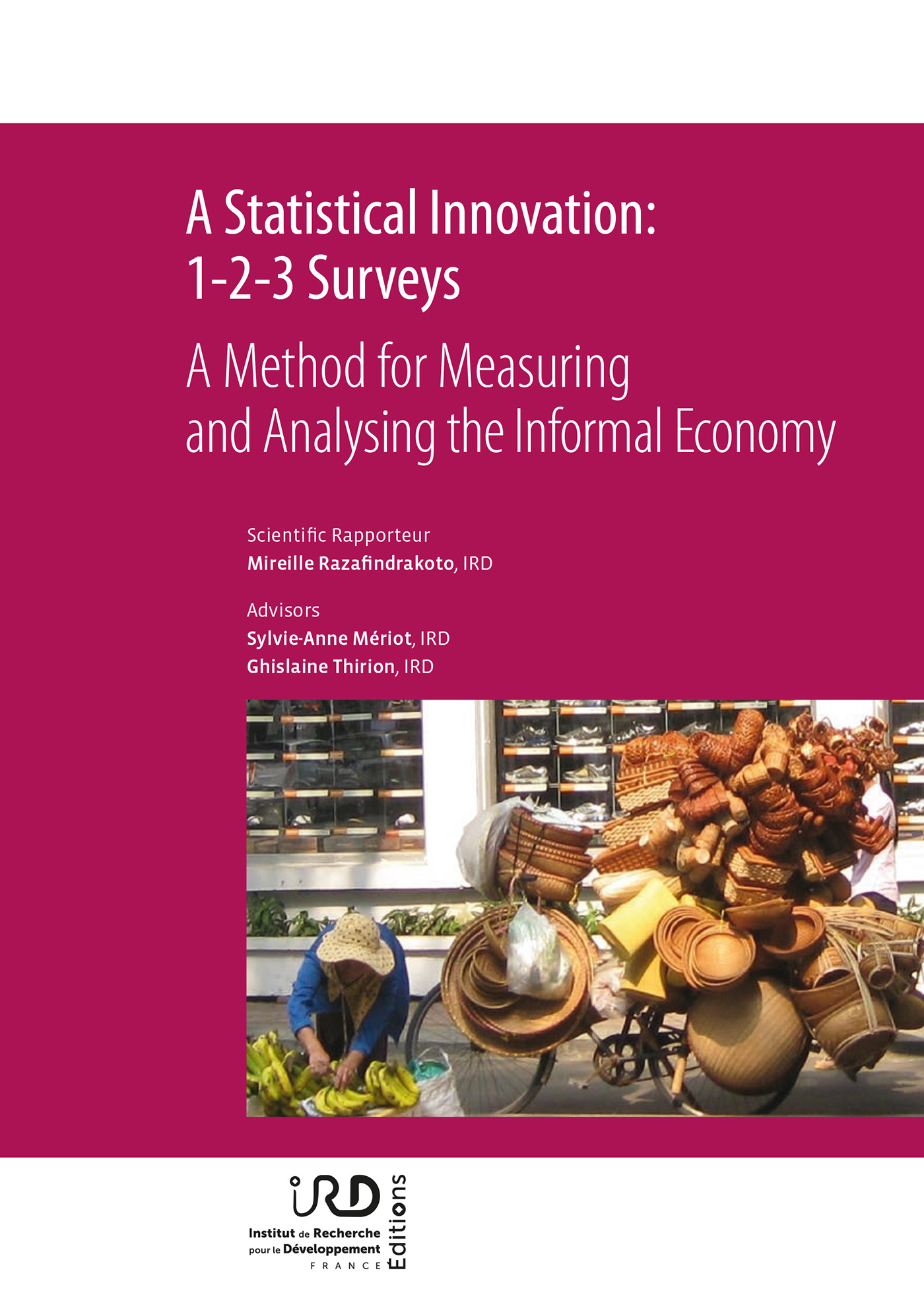
A Statistical Innovation: 1-2-3 Surveys
A Method for Measuring and Analysing the Informal Economy
Download Url(s)
https://books.openedition.org/irdeditions/58376Contributor(s)
Mériot, Sylvie-Anne (editor)
Thirion, Ghislaine (editor)
Zucker, Jean-Daniel (editor)
Language
EnglishAbstract
At the heart of development issues, the informal economy has long remained a terra incognita. Yet it plays a decisive role in the Global South, since it is the main source of income for the vast majority of households, especially the poorest. Indeed, the vast majority of jobs in these countries belongs to the informal economy. Given the stakes involved, the 1-2-3 survey method has made it possible to meet a twofold challenge, both statistical and economic: to measure what escapes measurement - the informal economy, and to understand how it operates and its dynamics. This methodology was developed and consolidated by the IRD through various national and regional projects launched from the early 1990s onwards, and conducted in close partnership with national statistical institutes, in collaboration with research centers and universities, regional bodies, agencies and donors. This study retraces the work carried out in three countries - Peru, Madagascar and Vietnam. It describes how the research results have had an impact in the social, economic, institutional, political, academic and capacity-building fields.
Keywords
1-2-3 surveys; Madagascar; Vietnam; Peru; development; statistics; economy; informal economy; law; societal impact; economic impact; social impact; political impact; public policy; capacity building; measurement tool; stakeholders; skills transfer; partnership researchDOI
10.4000/131hnISBN
9782709929837Publisher
IRD ÉditionsPublisher website
http://books.openedition.org/irdeditionsPublication date and place
Marseille, 2023Series
Chemins d’impacts,Classification
Development economics and emerging economies
Social research and statistics
Pages
60
Except where otherwise noted, this item's license is described
as
https://creativecommons.org/licenses/by-nc-nd/4.0/