
Harlem in Disorder
A Spatial History of How Racial Violence Changed in 1935
Abstract
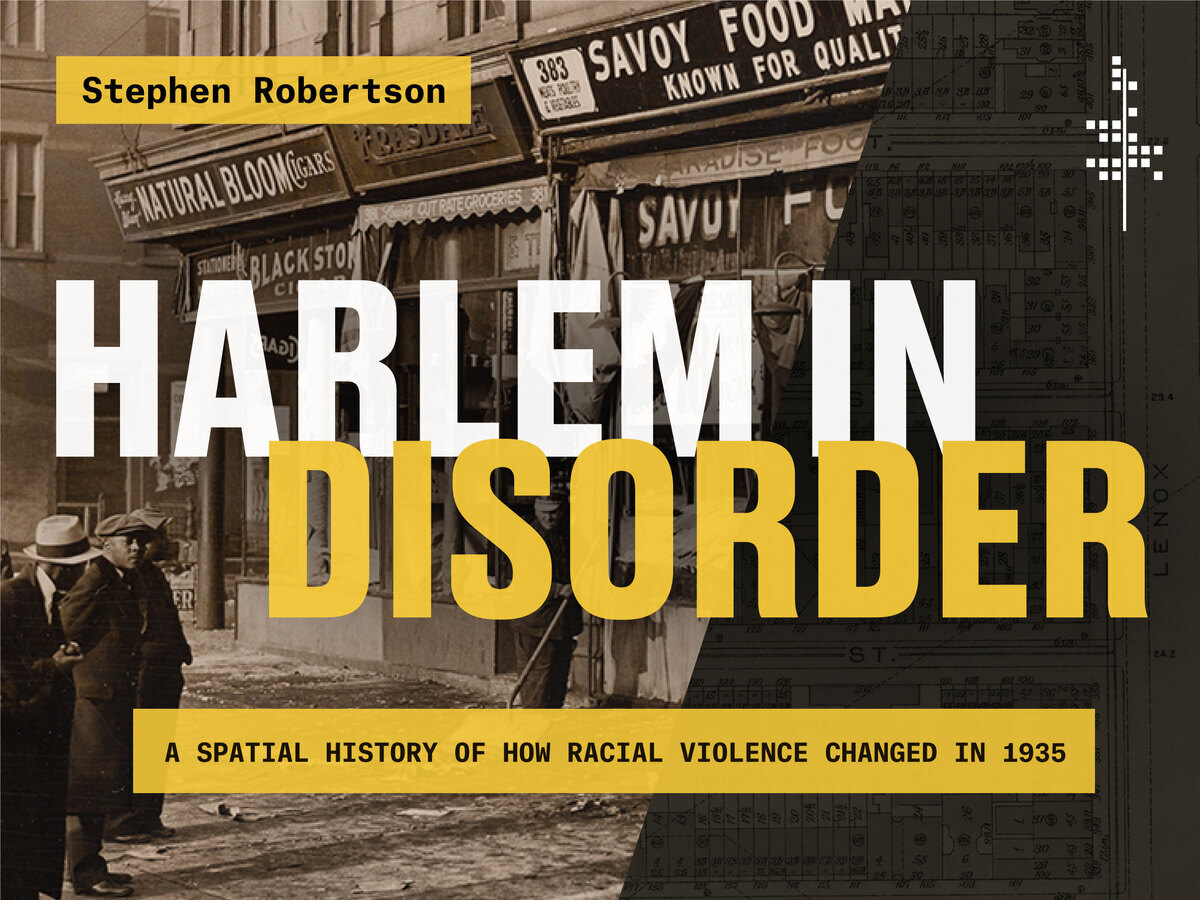
The violence that spread across Harlem on the night of March 19, 1935 was the first large-scale racial disorder in the United States in more than a decade and the first occurrence in the nation's leading Black neighborhood. However, as many observers pointed out, the events were "not a race riot" of the kind that had marked the decades after the Civil War. Racial violence took a new form in 1935. Through a granular analysis of those events and the mapping of their locations, Harlem in Disorder reveals that Harlem's residents participated in a complex new mix of violence that was a multifaceted challenge to white economic and political power. Tracing the legal and government investigations that followed, this project highlights how that violence came to be distorted, diminished, and marginalized by the concern of white authorities to maintain the racial order, and by the unwillingness of Harlem's Black leaders and their white allies to embrace fully such direct forms of protest. Focused on capturing rather than simplifying the complexity of the new form of racial violence, Harlem in Disorder is a multilayered, hyperlinked narrative that connects different scales of analysis: individual events, aggregated patterns, and a chronological narrative. Its structure foregrounds individual events to counter how data can dehumanize the past, and to make transparent the interpretations involved in the creation of data from uncertain and ambiguous sources.
Keywords
Harlem; new york; riots; Mayor’s Commission on Conditions in Harlem; 1935DOI
10.21627/2024hdWebshop link
https://www.harlemindisorder.orgISBN
9781503630451Publisher
Stanford University PressPublication date and place
2024Classification
History of the Americas
United States of America, USA
20th century, c 1900 to c 1999
Social discrimination and social justice
Violence and abuse in society

Except where otherwise noted, this item's license is described
as
https://creativecommons.org/licenses/by-nc-nd/4.0/