
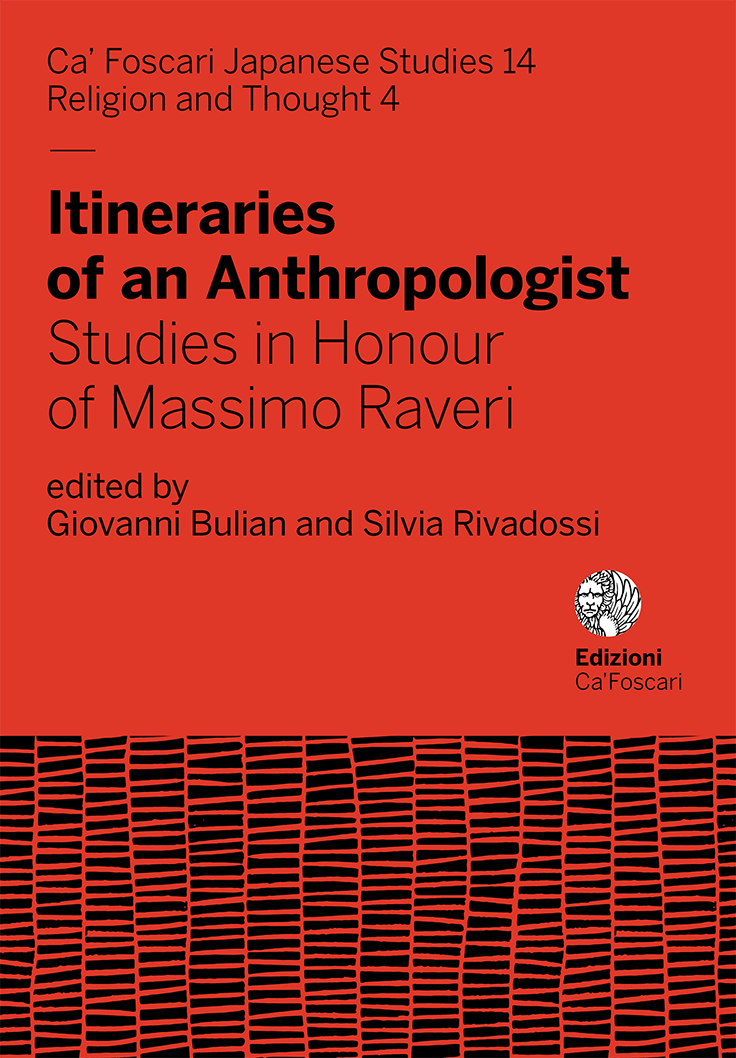
Itineraries of an Anthropologist
Studies in Honour of Massimo Raveri
Download Url(s)
https://edizionicafoscari.unive.it/media/pdf/books/978-88-6969-528-5/978-88-6969-528-5.pdfLanguage
EnglishAbstract
This book is being dedicated to Massimo Raveri on the occasion of his retirement. It is designed to recreate the various thematic itineraries that he has traced and followed in his career. Each of the essays included represents a topic in which Prof. Raveri has shown great interest, paving the way for further studies. In offering these essays to him, his friends and colleagues are both bearing witness to his interest in such topics and contributing to their study. Contributions by former students of Prof. Raveri’s further show how these fields of study are being developed in his footsteps.
Keywords
Landscape,Contemporary Japan,Iwashimizu Hachimangū,Japanology,Hiyoshi Taisha,Cultural heritage,Discourse analysis,Sathya Sai Baba,Environmental sustainability,Guru,Shugendō,Engi,Fascism,Kumano,History of thought,Japanese Fascism,Japanese Imperialism,Ritual,Shaman,Philosophy of music (Japan),‘Dialogical dialogue’,Japanese religions,Pilgrimage,AI,Polythetic class,Philosophical truth,Buddhism and music,Goryōe,First public discourse,Historiography,Shinbutsu,Massimo Raveri,Anthropology of Japan,Sutra of the Questions by Druma, King of the Kinna,Path to salvation,Oxford,Affect,Kagura,Armageddon,Philosophy of pure positive,Second World War,Shin-shin-shūkyō,Mindar,Mountain beliefs,Gagaku,Teachings,Satoyama,Mānasa Bhajare,Japanese Buddhism,Japan,Asahara Shōkō,Combinatory rituals,Amidist Buddhism,Japanese studies,Aum Shinrikyō,New-new religions,Robots,Social anthropology,Japanese shamanism,Apocalypticism,Buddhist wisdomISBN
9788869695278, 9788869695285Publisher
Fondazione Università Ca' FoscariPublisher website
edizionicafoscari.unive.itPublication date and place
2021Series
Ca’ Foscari Japanese Studies, 7
Except where otherwise noted, this item's license is described
as
https://creativecommons.org/licenses/by/4.0/