
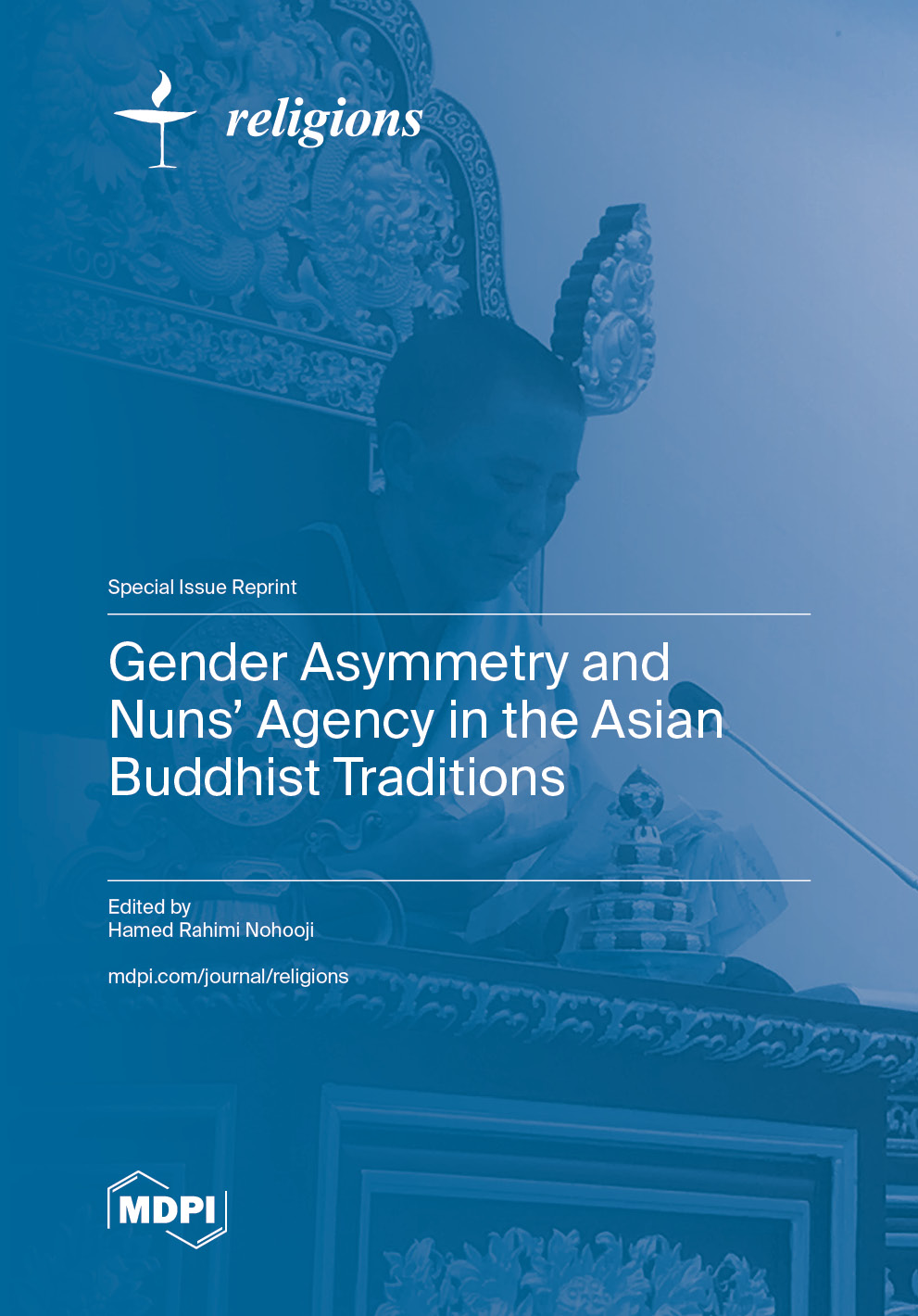
Gender Asymmetry and Nuns' Agency in the Asian Buddhist Traditions
Download Url(s)
https://mdpi.com/books/pdfview/book/8536Contributor(s)
Schneider, Nicola (editor)
Language
EnglishAbstract
In Buddhist monasticism, women are relegated to second rank, mainly for two reasons: first, they do not always have access to the same level of education as their male counterparts and are therefore not credited with the same learning (erudition); second, in some countries, they are excluded from one or all ordination rites. Thus, we have, on the one hand, full-fledged monks, and on the other, female religious practitioners who, in several Asian countries, are not ordained (Burma, Sri Lanka and Thailand) or are only semi-ordained (India, Mongolia, Nepal and Tibet). As for Chinese and Korean monasticisms, there are fully ordained nuns, but they still have to respect traditional norms regarding gender hierarchy. The resulting asymmetry between ordained men and women is a facet of living Buddhism. However, in recent decades, Buddhist nuns are also taking steps to resolve some of the discrimination they face, thereby showing their agency.
Keywords
Buddhism; Buddhist nuns; gender asymmetry; education; ordination; AsiaWebshop link
https://mdpi.com/books/pdfview ...ISBN
9783036598253, 9783036598260Publisher website
www.mdpi.com/booksPublication date and place
Basel, 2023Classification
Religion & beliefs
Religion and beliefs
Pages
250
Except where otherwise noted, this item's license is described
as
https://creativecommons.org/licenses/by/4.0/