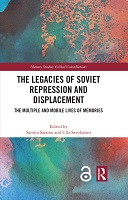
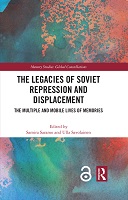
The Legacies of Soviet Repression and Displacement
The Multiple and Mobile Lives of Memories
| dc.contributor.editor | Saramo, Samira | |
| dc.contributor.editor | Savolainen, Ulla | |
| dc.date.accessioned | 2023-04-18T10:46:50Z | |
| dc.date.available | 2023-04-18T10:46:50Z | |
| dc.date.issued | 2023 | |
| dc.date.submitted | 2023-04-13T07:38:51Z | |
| dc.identifier | https://library.oapen.org/handle/20.500.12657/62356 | |
| dc.identifier.uri | https://directory.doabooks.org/handle/20.500.12854/99362 | |
| dc.description.abstract | This book explores the ways in which memories of Stalin-era repression and displacement manifest across times and places through diverse forms of materialization. The chapters of the book explore the concrete mobilities of life stories, letters, memoirs, literature, objects, and bodies reflecting Soviet repression and violence across borders of geographical locations, historical periods, and affective landscapes. These spatial, temporal, and psychological shifts are explored further as processes of textual circulation and mediation. By offering novel multi-sited and multi-media analyses of the creative, political, societal, cultural, and intimate implications of remembrance, the collection contributes fresh interdisciplinary perspectives to both the field of memory studies and the study of Soviet repression. The case studies in this collection focus on the personal, autobiographical, and intimate representations, experiences, and practices related to the remembrance of Stalinist repression and displacement as they are mediated through memoirs, fiction, interviews, and versatile commemorative practices. Taken together, the book asks: what happens to memories, life stories, testimonies, and experiences when they travel in time and space and between media and are (re)interpreted and (re)formulated through these transfers? What kinds of memorial forms are gained through processes of mediation? What types of spaces for remembering, telling, and feeling are created, negotiated, and contested through these shifts? What are the boundaries and intersections of intimate, familial, community, national, and transnational memories? By analytically contextualizing the various case studies within broader memory discourses in a range of geographical and political contexts, the book offers rich and multilayered interpretations of the enduring ramifications of communist repression. The collection demonstrates that these multiply moving memories not only reflect Eastern European memory culture but reach far beyond and have transnational and transgenerational significance. As such, this timely book will be essential reading for anyone with an interest in the former Soviet Union or memory studies more broadly. | |
| dc.language | English | |
| dc.relation.ispartofseries | Memory Studies: Global Constellations | |
| dc.rights | open access | |
| dc.subject.classification | thema EDItEUR::J Society and Social Sciences::JH Sociology and anthropology::JHB Sociology | en_US |
| dc.subject.classification | thema EDItEUR::J Society and Social Sciences::JP Politics and government | en_US |
| dc.subject.other | Baltic; Collective memory; Commemoration; Communism; Eastern Bloc; Eastern Europe; Emotion; Experiences; Life stories; Materiality; Memory; Memory studies; Mobility; Repression; Soviet Terror; Soviet Union; Stalin; Terror; Violence | |
| dc.subject.other | thema EDItEUR::J Society and Social Sciences::JH Sociology and anthropology::JHB Sociology | |
| dc.subject.other | thema EDItEUR::J Society and Social Sciences::JP Politics and government | |
| dc.title | The Legacies of Soviet Repression and Displacement | |
| dc.title.alternative | The Multiple and Mobile Lives of Memories | |
| dc.type | book | |
| oapen.identifier.doi | 10.4324/9781003305569 | |
| oapen.relation.isPublishedBy | fa69b019-f4ee-4979-8d42-c6b6c476b5f0 | |
| oapen.relation.hasChapter | Chapter Introduction | |
| oapen.relation.hasChapter | Chapter 3 Mnemonic Affordances of Family Photographs | |
| oapen.relation.hasChapter | Chapter 5 On the Role of the Individual in Materializing, Mediating, and Commemorating Memories of the Stalinist Repressions | |
| oapen.relation.hasChapter | Chapter 10 Complicity in Commemoration | |
| oapen.relation.isbn | 9781032305257 | |
| oapen.relation.isbn | 9781032305264 | |
| oapen.relation.isbn | 9781003305569 | |
| oapen.imprint | Routledge | |
| oapen.pages | 260 | |
| peerreview.review.type | Proposal | |
| peerreview.anonymity | Single-anonymised | |
| peerreview.reviewer.type | Internal editor | |
| peerreview.reviewer.type | External peer reviewer | |
| peerreview.review.stage | Pre-publication | |
| peerreview.open.review | No | |
| peerreview.publish.responsibility | Publisher | |
| peerreview.id | bc80075c-96cc-4740-a9f3-a234bc2598f1 | |
| peerreview.title | Proposal review |
Fichier(s) constituant ce document
| Fichiers | Taille | Format | Vue |
|---|---|---|---|
|
Il n'y a pas de fichiers associés à ce document. |
|||
Ce document figure dans la(les) collection(s) suivante(s)
Chapters in this book
-
(2013)In this book, we discuss the changing medical and public profile of fungal infections in the period 1850–2000. We consider four sets of diseases: ringworm and athlete’s foot (dermatophytosis); thrush or candidiasis (infection ...
-
(2023)This chapter contributes to the discussions on memorability by applying assemblage theoretical thinking to the analysis of memory and by developing the notion of mnemonic affordance. It analyzes Ella Ojala’s family ...
-
(2023)This study combines economic, biographical, performative, and narrative approaches to commemoration to understand how the memory of the Stalinist repressions gains mnemonic capital through individualized practice. It is ...